MCA OOW (Unlimited) Orals Prep
Work less,
sail more
Everything for your OOW orals in one place, and a plan that tells you what to do each day — whether you’re on seatime or your orals are booked.
Cheaper than a mock. Faster than a textbook.
“Whoever said smooth seas never made a skilled sailor clearly wasn’t a Lazy Sailors Club member.”
read by hand
with full answers
quoted from the reports
Feb 2022 – Nov 2026
| FULL OOW Unlimited syllabus covered | ✕ | ✕ | ✓ |
|---|---|---|---|
| 132 questions, ranked by likelihood | ✕ | ✕ | ✓ |
| ALL written answers | ✕ | ✕ | ✓ |
| Mock exams | ✕ | ✕ | ✓ |
| COLREGs game and quizzes | ✓ | ✓ | ✓ |
| Custom revision plan/guide | ✓ | ✓ | ✓ |
✓Included✓Partial✕Not included
Tap Free, COLREGs or Full above to compare

Open it. It tells you what to do today. That’s it, that’s the whole idea.
Be honest
This is what revising looks like right now.
A chapter on weather. Then another on fronts. Then a forum thread arguing about both. Somewhere in there is the thing the examiner actually wants you to say.
CHAPTER 7 — PRESSURE SYSTEMS AND THEIR ASSOCIATED WEATHER
The distribution of atmospheric pressure over the earth’s surface is represented on the synoptic chart by isobars, lines joining places of equal pressure reduced to mean sea level. The spacing of these isobars is a direct indication of the pressure gradient, and hence of the strength of the gradient wind; where the isobars lie close together the gradient is steep and winds are strong, whereas widely spaced isobars indicate a slack gradient and light, often variable, winds.
A depression, or low, is a region of relatively low pressure around which the air circulates in an anticlockwise direction in the northern hemisphere. Depressions of the temperate latitudes generally form on the polar front, where warm moist tropical air meets cold polar air. As the wave on the front develops, a warm sector forms between the warm front ahead and the cold front behind. On the synoptic chart the fronts are distinguished by their symbols, and the navigator should be able to describe the sequence of weather each will bring. In summary, WARM front - (semicircles) steady continuous rain ahead, lowering stratiform cloud (Ci→Cs→As→Ns), veering wind and rising temp as it passes. The first sign is usually high cirrus some hundreds of miles ahead of the surface front, thickening to cirrostratus with its characteristic halo about the sun or moon, followed by altostratus and finally nimbostratus, while the barometer falls steadily and visibility deteriorates in the precipitation. Within the warm sector the weather is typically mild with low stratus, drizzle and poor visibility, and the barometer remains steady. The passage of the cold front is marked by a sudden veer of the wind, a rise in pressure, a fall in temperature and dew point, and heavy showers, frequently with thunder, from cumulonimbus cloud.
Visibility usually improves markedly behind the cold front. As the depression matures, the cold front overtakes the warm front and the system becomes occluded; the occlusion may display the characteristics of either a warm or a cold front depending upon the relative temperatures of the air masses involved. Near the surface, friction reduces the wind speed and therefore the Coriolis deflection, so that the surface wind blows across the isobars towards the lower pressure.
That yellow line is the answer. Don’t waste your time reading fluff.
Same facts. A fraction of the reading. More time for the pub.
Try it · no sign-up
Have a go. It’s the real app.
Open a topic, read a full answer, build a plan to your date. Everything here works exactly as it does inside.
One full answer is free to read. The other 131 are in the app.
Unlock all 132 answers — £14.99/month →COLREGs situation practice
A COLREGs, buoyage and lights simulator: day, night and fog.
Stand on a real bridge. Take bearings, identify her, tick your rules, give your orders, then watch her pass. 145 situations, by day, by night and in restricted visibility.

Play it here. One situation, start to finish: bearings, risk of collision, identify her, your rules, your orders. The walkthrough shows each step if you want it.
Just want the game and the quizzes? COLREGs only, £9.99 a month
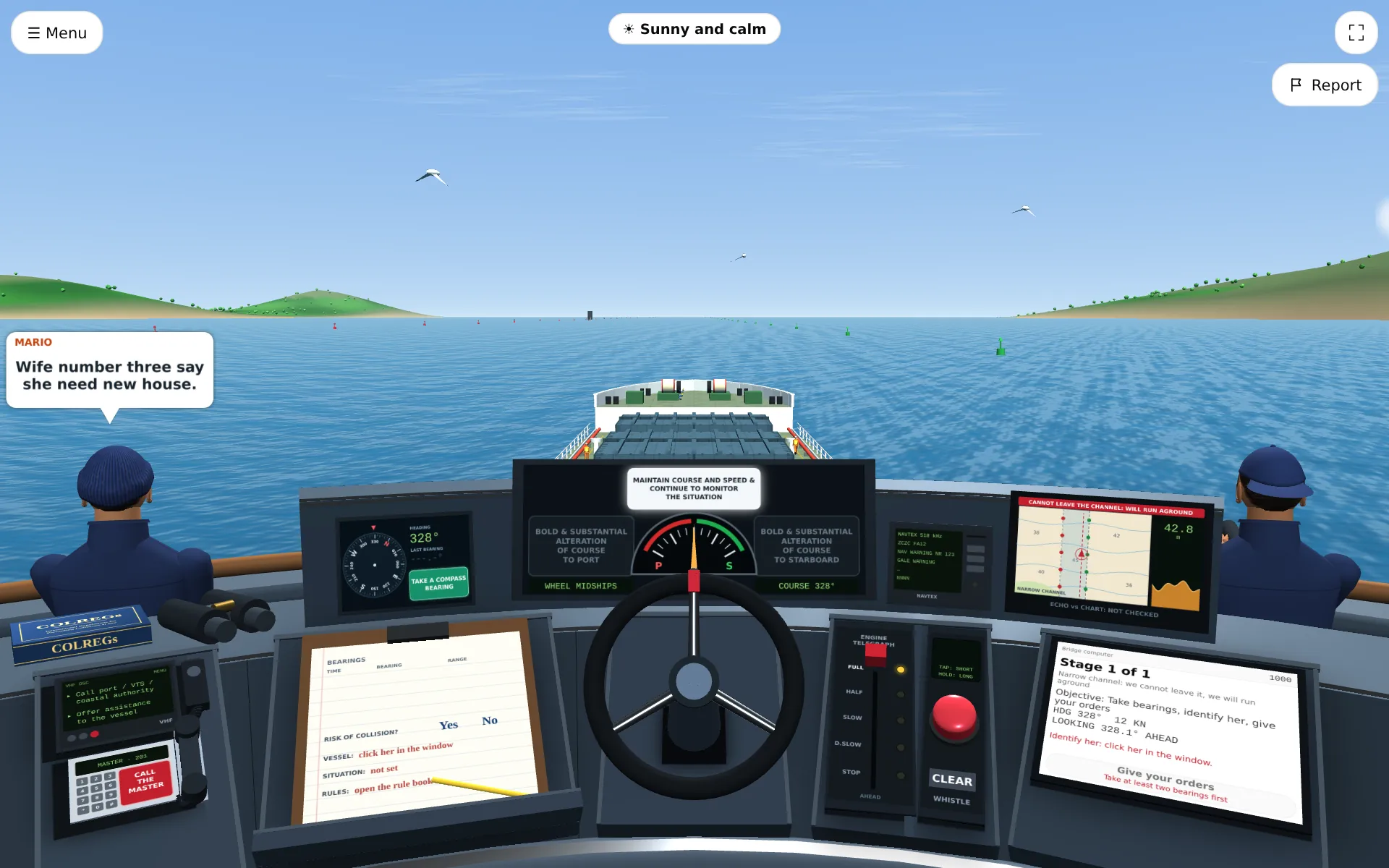
Narrow channelsRule 9: keep to starboard. Can you leave the channel? 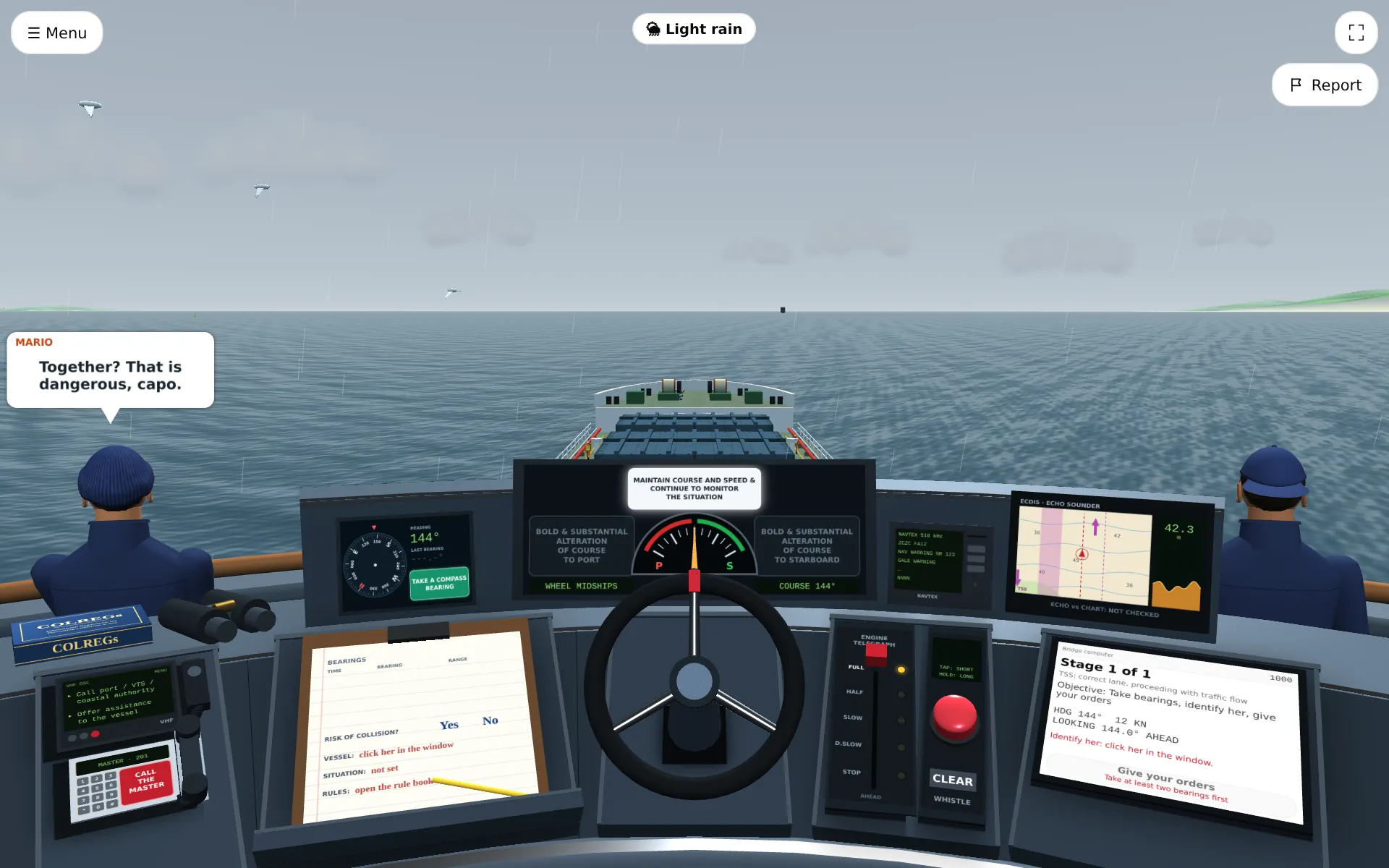
Traffic separation schemesRule 10: lanes, crossing, and who shall not impede. 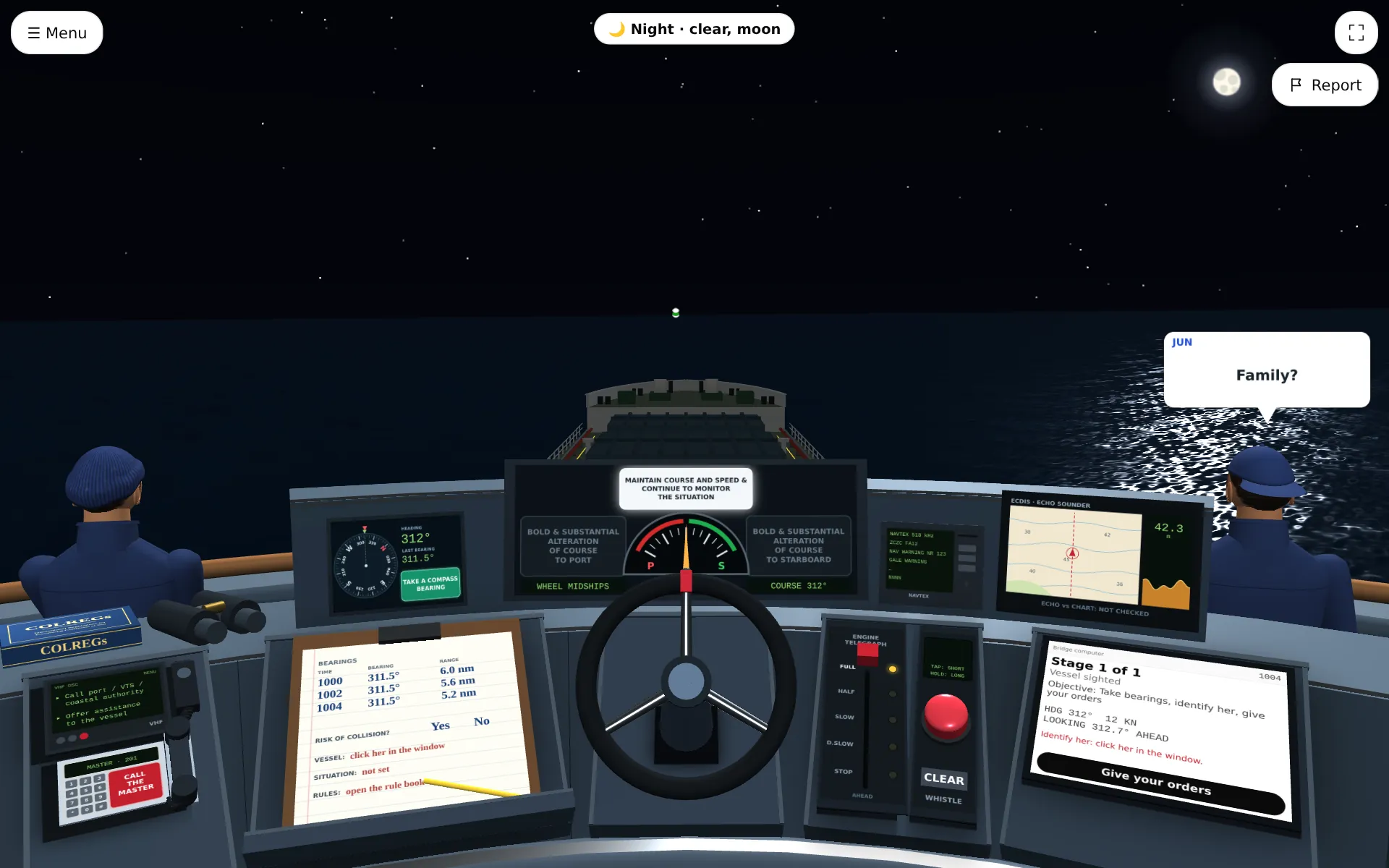
Lights at nightRead her lights, then act as you would by day. 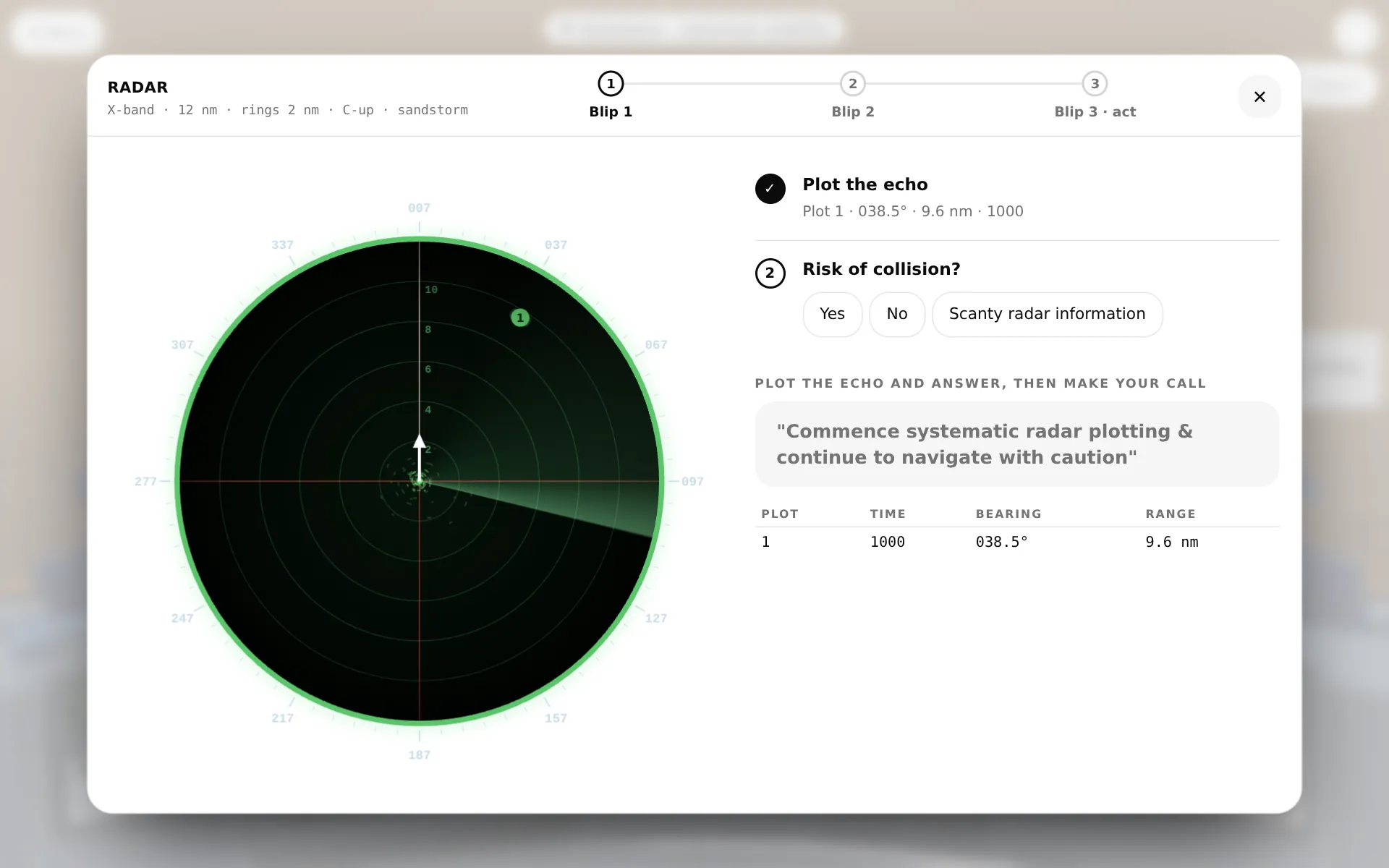
Restricted visibilityPlot her on the radar: three blips, then the OAW lines. 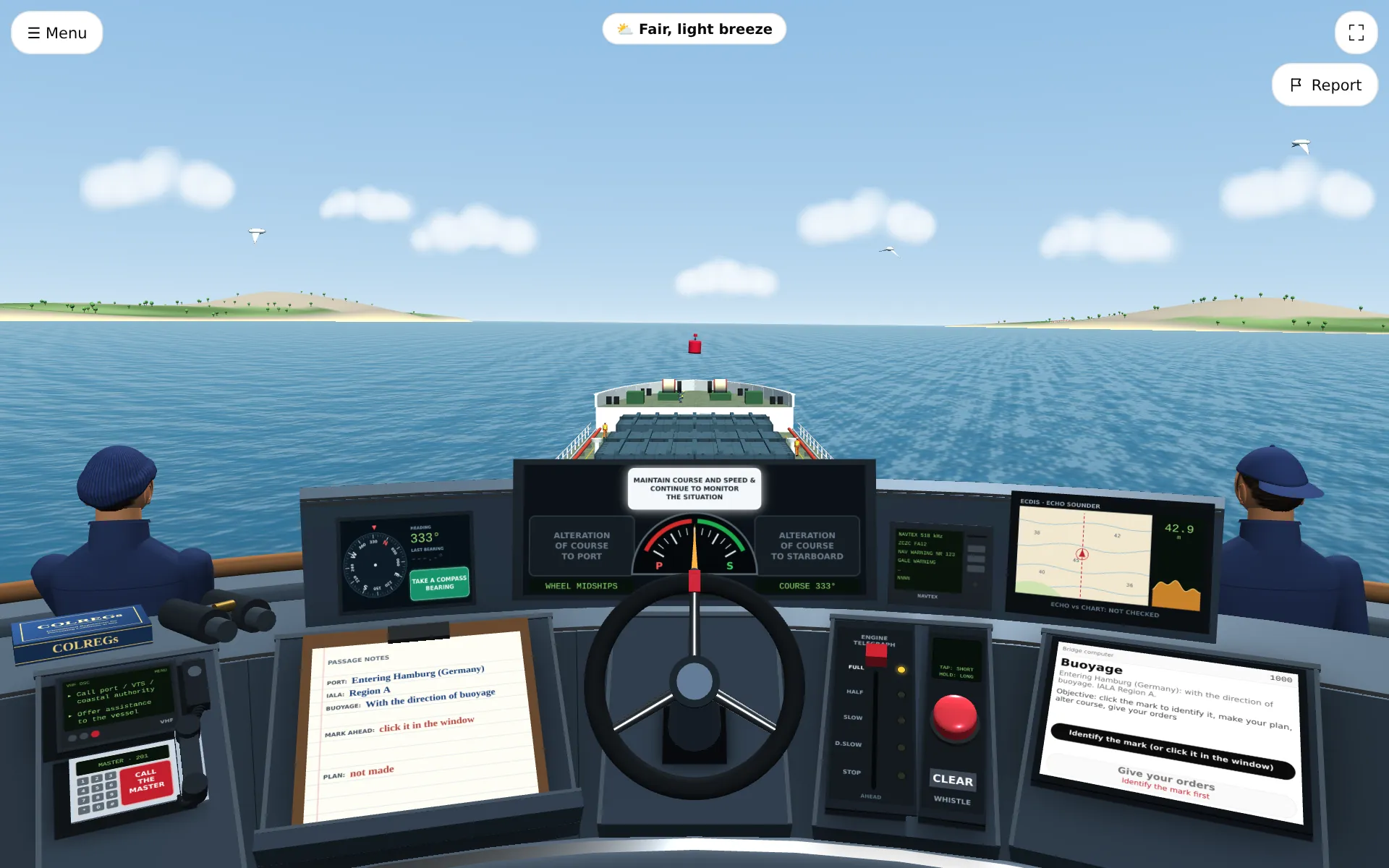
BuoyageIdentify the mark ahead and pass it the right side. 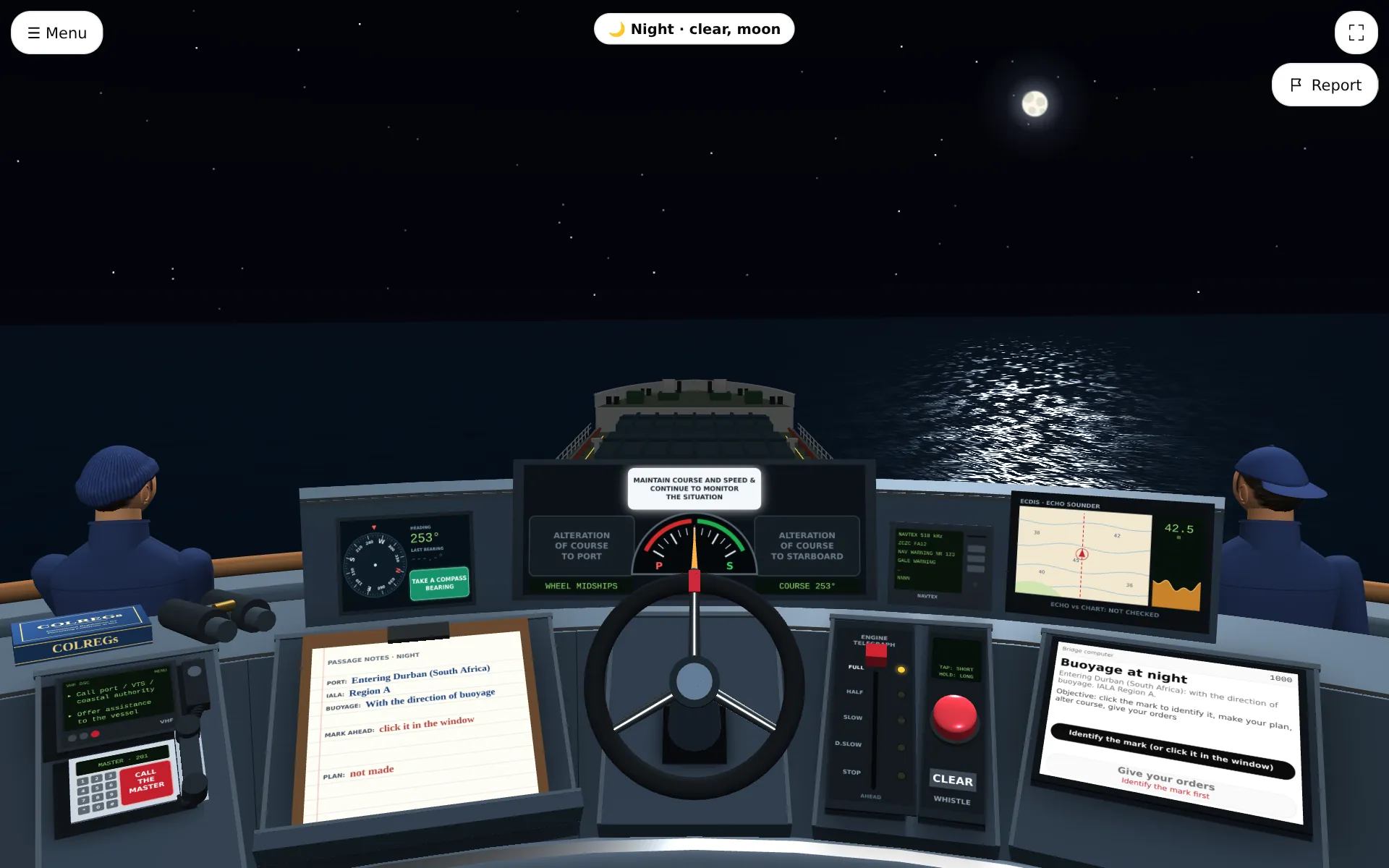
Buoyage at nightName the light, then the mark, then where to go.
What’s inside
Four tools. One app.
Then it gets better
We tell you how it’s asked.
Examiners don’t read from a script. The same question turns up a dozen ways — so every card shows the real wordings examiners have used.
Say it out loud. Hit reveal. Mark yourself. Next.
“What is your understanding of synoptic charts?” — one of six ways it’s been put.

Got a gap? Look it up.
Type it in. Get exactly what you need to know.
No index. No chapter. No forum thread from 2014. Search a bit of kit or an acronym and you get every question it turns up in, and the answer you’d actually say.
- GMDSS & CommunicationsEPIRB — operation, tests, frequencies, accidental activation
- GMDSS & CommunicationsGMDSS sea areas, equipment for each, and key frequencies
- Emergencies & ProceduresDistress signals (Annex IV) and distress vs urgency vs safety
- GMDSS & CommunicationsGMDSS routine checks — daily, weekly, monthly; log entries
- Emergencies & ProceduresAbandon ship — order, what to take from the bridge, in the liferaft
- 01
Type a word
Anything you’re shaky on. One word is enough.
- 02
See where it comes in
Every question it shows up in, all in one list.
- 03
Open the answer
Just the bit you say out loud. Then close the laptop.

Part A practice: 15 questions against the 40-minute clock, scored as in the exam.

Open one. ECDIS setup: four safety settings, five alarms, eight setup checks. Done.
Three weeks out and panicking?
Put your date in. We plan every day.
Pick the day you sit, the days of the week you’re free and how many topics a day. It fills in every study day between now and then, most-asked topics first.
Tick a task, it counts. Fall behind, it tells you. Bluntly.

Fancy a change?
Quizzes, mocks — and two games.
Lights, flags, IMDG placards, SOLAS, buoyage. Ten at a time. And a full timed mock exam when you’re feeling brave.
Yes, there’s a shooter where you sink boats by their lights. It counts as revision. We checked.

Still on seatime?
It’s also great for seatime.
Orals not for ages? Doesn’t matter. Sunday study day comes round and you spend half of it working out what to study. Most cadets at sea end up a bit lost.
Open this instead. It picks what to study, so you always know what to do next. Do one, tick it off, enjoy the rest of your Sunday.
- A casual study partner for the trip. Twenty minutes after a watch, a topic on a Sunday. Put in an orals date months away and the plan spreads it out to fit.
- Cheap enough to leave running. £14.99 a month is about 50p a day.
- Going on leave? Cancel online in under a minute. Everything you’ve done stays on your account for next trip.

Why us
More analysis. Sharper answers. Not £150.
Precise, sharp answers to the whole syllabus. And bluntly, we don’t cost £150.
Great reviews (apparently)
“I defeated the Franco-Spanish fleet at the battle of Trafalgar using what I learned from Lazy Sailors Club… Wow and for that price?”
“Lazy Sailors Club’s explanation of the differences between the three types of M notices really helped me survive the winter trapped between two converging walls of sheet ice on a wooden ship.”
“Lazy Sailors Club’s great explanation of MARPOL discharge limits really helped me stay compliant when circumnavigating the globe with a magnetic compass and a ship that had been at sea for so long it was rotting down to the waterline.”
“Lazy Sailors Club really helped me remember the five mandatory ECDIS alarms while I was eyeballing a continent we didn’t even know existed before I drew it by hand.”
Pricing
Less than a round of pints.
Orals booked? Revise for a few weeks, pass, cancel. Still on seatime? Leave it running for about 50p a day.
| FULL OOW Unlimited syllabus covered | ✕ | ✕ | ✓ |
|---|---|---|---|
| 132 questions, ranked by likelihood | ✕ | ✕ | ✓ |
| ALL written answers | ✕ | ✕ | ✓ |
| Mock exams | ✕ | ✕ | ✓ |
| COLREGs game and quizzes | ✓ | ✓ | ✓ |
| Custom revision plan/guide | ✓ | ✓ | ✓ |
✓Included✓Partial✕Not included
Tap Free, COLREGs or Full above to compare
Cancel online any time.
Cards, Apple Pay and Google Pay, via Stripe.
Questions
The small print, in big letters.
Who’s it for?
Deck cadets and officers preparing for the MCA OOW (Unlimited) oral exam.
Is this an official MCA thing?
No. It’s an independent study aid, not affiliated with or endorsed by the Maritime and Coastguard Agency.
Who wrote the answers?
A serving OOW (Unlimited) deck officer wrote and reviewed them in September 2026. Always check against the current publications.
Will it get me through?
Nobody can promise that, and we won’t. It helps you practise properly, without the wasted hours.
Can I use it offline?
No. It needs a connection.
Can I share my account?
No. One person, one device at a time.
How do I cancel?
Account → Manage billing → Cancel. Under a minute. You keep access to the end of the month you’ve paid for.
Sitting soon?
The only revision prep website you can use 5 spritzes deep.
Twenty minutes from now you could know exactly what to revise tonight.